With the rapid maturation of Generative AI (GenAI), the landscape of cyberattacks is undergoing a structural transformation. Hacker behaviors, once dependent on human effort and time, are now being automated through AI for vulnerability analysis, attack script generation, and social engineering. This evolution has shifted ransomware from “isolated incidents” into scalable, industrialized threats.
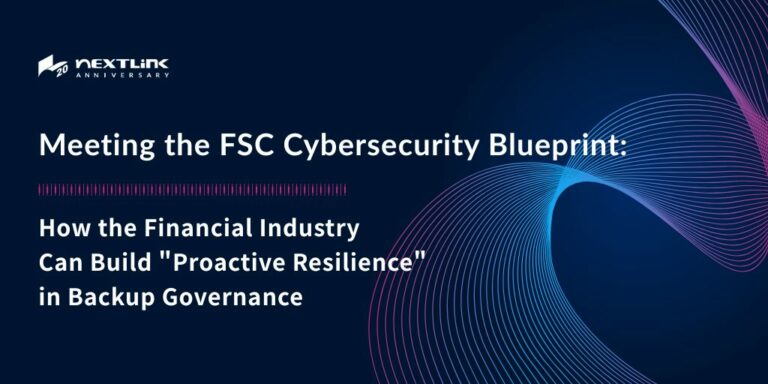
In early 2026, the Financial Supervisory Commission (FSC) released the “Financial Cybersecurity Resilience Development Blueprint,” signaling a pivotal shift in Taiwan’s financial supervision—from “passive compliance” to “active resilience.” In an era of AI-driven attacks, traditional off-site backups and data redundancy are no longer sufficient to safeguard operational assets. As threats become automated and destructive, how can financial institutions build true “Cyber Resilience”?
Table of Contents
Table of Contents
Defining Cyber Resilience: A Paradigm Shift from Backup to Survival
In the past, financial cybersecurity strategies were largely built on two pillars: “preventing intrusion” and “ensuring backups.” However, in today’s highly interconnected and cloud-native operational environment, enterprises can no longer assume that attacks can be entirely blocked.
While traditional cybersecurity focuses on “avoiding compromise,” Cyber Resilience asks: “When an attack is inevitable, can the enterprise maintain critical service operations?” Its core is not a single technology, but an integrated operational capability that combines detection, protection, isolation, and rapid recovery.
For financial institutions, cyber resilience represents more than just risk mitigation; it is about constructing a “predictable, defensible, and recoverable” financial ecosystem, ensuring that essential services remain uninterrupted even under extreme scenarios.
The AI-fication of Ransomware: Three Critical Cybersecurity Challenges for Finance in 2026
In recent years, ransomware has evolved from simple data encryption into multi-stage composite attacks. The integration of GenAI has introduced three fundamental changes to the attack lifecycle:
- AI-Accelerated Vulnerability Discovery: Hackers use AI to rapidly scan public systems and cloud configurations, analyzing weaknesses and automatically generating attack paths. Intrusions that once required weeks of planning can now be executed within hours.
- Highly Realistic Social Engineering: GenAI can mimic internal corporate tones and communication styles, creating hyper-realistic phishing emails and fraudulent instructions that easily bypass traditional employee training defenses.
- The Rise of Destructive Ransomware: Modern attacks do more than encrypt data; they simultaneously delete backups, destroy recovery mechanisms, and threaten to leak sensitive information. The objective has shifted from “extorting money” to “paralyzing operations.”
As ransomware becomes AI-driven, the core objective of financial cybersecurity is no longer just stopping the breach, but ensuring business continuity despite it.
Three Pillars of Financial Cyber Resilience: From Defense to Continuity
To truly implement cyber resilience, financial institutions must redesign their cybersecurity strategies at the architectural level. To meet the stringent regulatory and stability requirements of the industry, Nextlink Technology leverages cloud-native technologies to build three defensive pillars against AI threats:
Pillar 1: Proactive Detection and Continuous Monitoring
AI-driven attacks outpace human reaction times. This necessitates cloud-native security services and centralized monitoring platforms to analyze abnormal behaviors in real-time. Nextlink integrates cloud security frameworks with Managed Security Service Provider (MSSP) capabilities, helping financial institutions establish 24/7 monitoring to identify and neutralize threats before they propagate.
Pillar 2: Logical Isolation and Immutable Backups
Traditional off-site backups can fail simultaneously during a ransomware attack if environments are interconnected. Cyber resilience emphasizes Logical Isolation, including:
- Immutable Backup Mechanisms: Ensuring data cannot be altered or deleted.
- Credential and Account Segregation: Implementing a “Zero Trust” architecture. By using cloud isolation mechanisms, financial firms can ensure data integrity and a clean foundation for recovery, even if the primary environment is compromised.
Pillar 3: Automated Recovery and Continuous Drills
The greatest fear during a regulatory audit is a recovery process that is too slow or prone to failure. True resilience comes from verifiable recovery capabilities. Nextlink assists clients in establishing periodic drills and automated workflows, transforming cybersecurity from a cost center into a quantifiable, optimized operational metric.
Nextlink Technology: Safeguarding the Foundation of Trust
As regulatory requirements heighten and attacks grow in complexity, the challenge for the financial sector has shifted from “Digital Transformation” to “Building Cyber Resilience.”
With the AWS MSSP Competency certification, Nextlink Technology adheres to the highest international standards for security operations. We provide financial clients with cloud security architectures and continuous monitoring capabilities that align with FSC regulatory expectations.
Through our one-stop service model, Nextlink helps financial institutions design resilience governance models, providing 24/7 security monitoring, incident response, and continuous compliance optimization. Our track record includes assisting numerous insurance providers and public sectors in adopting cloud services while maintaining the strictest regulatory standards.
The core competitiveness of the financial industry is not just technology—it is the trust of customers in uninterrupted service. As AI automates and scales attacks, cyber resilience becomes the core asset ensuring operational stability.
Contact Nextlink Technology today to build a more resilient and trusted financial future.