Table of Contents
Table of Contents
The Deployment Bottleneck: AI Hallucinations and Messy Architecture
In the era of artificial intelligence, true competitive advantage doesn’t come from Large Language Models (LLMs) alone. It lives in your core enterprise data. Over the past two years, every company looking to transform has asked the same question: “When can we get our own custom AI application?” From intelligent customer service to internal knowledge assistants, AI tools seem to be rolling out faster than ever. Yet, during implementation, teams often hit a wall. Even with the latest LLMs, AI still delivers inaccurate answers, references outdated information, or confidently invents facts—a phenomenon known as AI hallucination.
To keep AI grounded in truth, Retrieval-Augmented Generation (RAG) has become the industry standard. RAG works by letting the AI look things up in a company’s database before it answers, using that evidence to generate a response. This drastically improves accuracy and trustworthiness. However, when technical teams actually build a RAG architecture, they usually run into two new challenges.
The Double-Data Track: Syncing Vector and Traditional Data
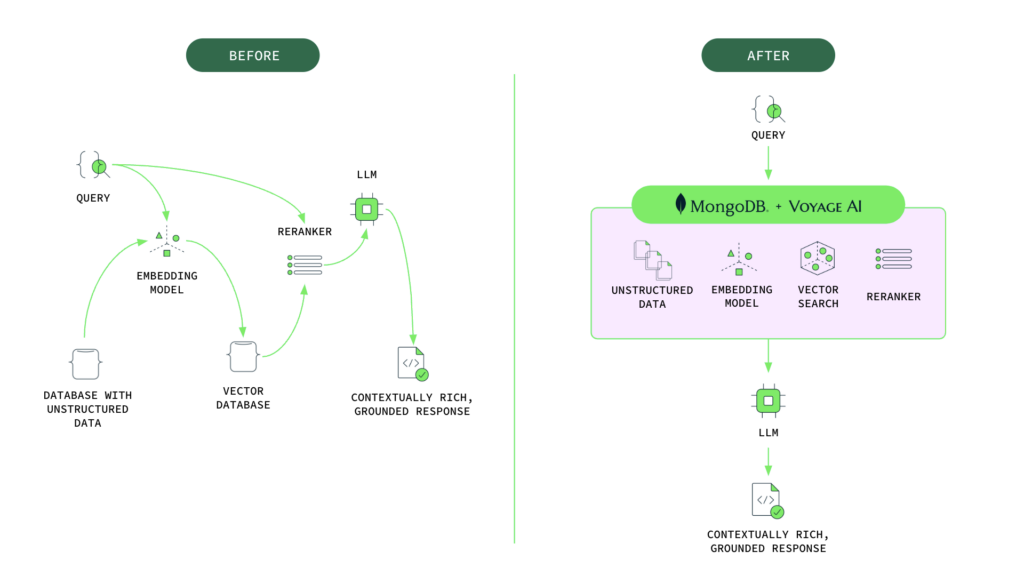
Core corporate data lives in traditional databases. To make it readable for an AI, teams must call external APIs to convert that data into vectors, which are then saved in a separate vector database. Because these two systems do not sync in real time, updates lag, raising the risk that the AI will give inconsistent answers.
Tool Bloat: Messy Architecture and High System Latency
A complete retrieval pipeline often requires stitching together relational or non-relational databases, vector databases, embedding APIs, and reranking models. This patchwork architecture costs a lot to maintain and adds significant response latency, severely dragging down performance.
To solve this challenge, MongoDB natively integrated Voyage AI’s embedding and reranking models directly into the MongoDB Atlas data platform, giving companies a fast track to highly accurate AI.
Two Core Technologies for Precise RAG Retrieval
Before looking at how MongoDB integrates Voyage AI, we need to understand the two core technologies that dictate how accurately a RAG architecture retrieves information.
1. Vector Embedding Models: Mapping Text into Coordinates the AI Understands
AI cannot read human language directly, it requires a numerical representation. An embedding model converts blocks of text into a set of numerical coordinates called vectors. For example, the word “apple” might become [0.11, -0.23, 0.57, …]. Words with similar meanings cluster close together in this mathematical space. The AI can then use geometric distance to judge how similar pieces of text are, completing the first stage of retrieval.
2. Reranking Models: Sifting Out the Most Relevant Content
First-stage vector searches pull a broad set of relevant results from massive datasets, but they might miss the exact context. This is where a reranking model comes in for a second pass. The reranker uses a more advanced model to reorder the results based on how relevant they actually are to the user’s question. It then hands only the best matches to the LLM to generate the final answer, ensuring the response remains highly trustworthy.
Without embeddings, the AI cannot find relevant data. Without a reranker, the data it reads may lack precision. Both are essential.
Simplifying AI Development with MongoDB and Voyage AI
MongoDB is one of the world’s most popular NoSQL databases, it stores data in JSON documents, making it far better suited for handling massive amounts of unstructured and semi-structured data than traditional relational databases. Voyage AI leads the industry in AI retrieval models, offering incredibly precise semantic understanding.
By natively integrating Voyage AI’s embedding and reranking technology into MongoDB Atlas, the platform transforms a fragmented, inefficient development process in three ways:
- Automated Vector Generation (Auto-Embedding): When you save JSON documents in MongoDB Atlas, the system automatically calls the built-in Voyage AI models in the background to generate vectors. Developers no longer need to write custom code to call external APIs and manually save the vectors back, which keeps data and vectors perfectly synced and reduces management overhead.
- Natively Integrated MongoDB Vector Search: Developers can run vector searches and precise filtering simultaneously using a single syntax within MongoDB’s Aggregation Pipeline. Running the entire workflow on a single data platform eliminates cross-system integration and data migration, streamlining application development.
- Support for Multimodal Search and Specialized Models: Beyond text, Voyage AI supports multimodal retrieval to handle images, videos, and audio. It also offers models optimized for specialized industries like law, finance, and software engineering, helping companies build AI applications tailored to their specific business needs.
| Core Element | Fragmented Traditional Process | Integrated MongoDB + Voyage AI Architecture |
|---|---|---|
| Vector Generation | Requires custom code to call external APIs and manual syncing back to a vector database. | Auto-Embedding: The system automatically generates and syncs vectors in the background after JSON documents are saved. |
| Development Syntax & Platform | Straddles multiple databases and vector platforms, making maintenance and integration complex. | Native Vector Search: Runs vector searches and precise filtering within the MongoDB Aggregation Pipeline using a single syntax. |
| Industry Specialization | General-purpose models offer poor retrieval accuracy for specialized industries like law or finance. | Specialized Model Support: Supports multimodal retrieval (text, images, video, audio) and includes specialized models optimized for finance, law, and code. |
Three Values Delivered to Enterprises
1. Lower Total Cost of Ownership (TCO)
By consolidating databases, vector search, and AI retrieval, companies no longer need to purchase, learn, and maintain multiple tools or data-syncing pipelines. Development teams can focus entirely on MongoDB’s familiar infrastructure, drastically cutting operational and labor costs.
2. Fewer Hallucinations and Better User Experiences
Voyage AI’s embedding and reranking models allow LLMs to pull the most precise, contextually relevant internal knowledge. When an AI responds using accurate, up-to-date data, it reduces hallucinations and builds trust with customers and employees alike.
3. Faster Deployment with Enterprise-Grade Security
Because data and vectors are processed entirely within the secure boundary of MongoDB Atlas, companies do not have to move sensitive data across the public internet between multiple third-party APIs. This meets enterprise security and compliance standards, helping projects move quickly from proof-of-concept to production.
True AI Advantages Stem from Smart Data Use
The generative AI race is not just about model parameters or computing power. It is about how quickly and accurately a company can leverage its internal knowledge. As RAG becomes the dominant architecture for enterprise AI, the integration efficiency between your database, vector search, and retrieval models directly dictates your AI’s response quality and speed. Instead of wasting time stitching together fragmented infrastructure, companies should choose platforms with native AI retrieval capabilities so their developers can focus on creating business value.
As a designated strategic partner for MongoDB, Nextlink helps enterprises plan AI and data architectures tailored for growth. We offer one-stop local services ranging from MongoDB implementation and RAG architecture design to AI application development, maintenance, and optimization. Reach out today to start the next chapter of your enterprise AI and data intelligence journey.
FAQ
Q1: Is MongoDB Atlas suitable as a vector database?
Yes. MongoDB Atlas features built-in Vector Search, meaning companies do not need to buy a separate vector database for AI applications. You can handle traditional structured queries, full-text searches, and vector searches simultaneously within MongoDB, eliminating data sync delays and tool bloat.
Q2: What advantages does Voyage AI have over other embedding models?
Voyage AI focuses specifically on optimizing retrieval quality. In industry benchmarks, its embedding and reranking models excel at capturing semantic meaning and handling long texts. It also offers specialized models optimized for fields like law, finance, healthcare, and coding, delivering much higher retrieval accuracy than general-purpose models from larger providers.